

One thing that I have learned repeatedly over the past 11 years or so, which of course I already knew, is that there’s always new skills to learn. Steepest learning curve of my early Ph.D. process was definitely the R programming language. I ended up doing maybe 80% of the data analysis for the dissertation in R, as well as graphics. Incredible process for me at 52. I have gotten more fluent in R over the past five years or so especially, since moving on, getting a postdoc, and continuing to work in the R environment.
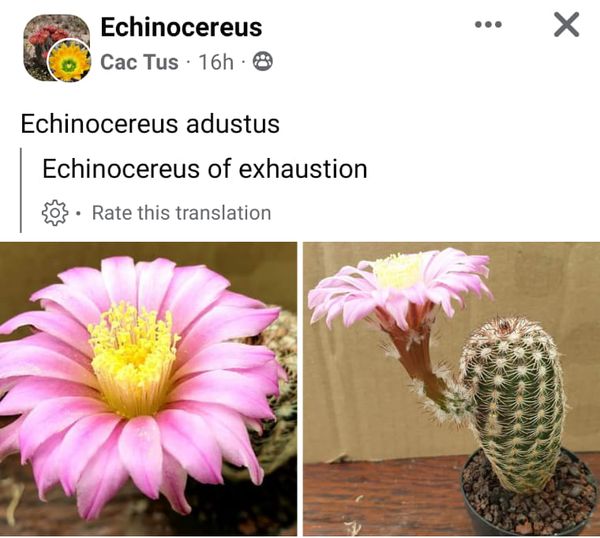
But the Echinocereus of exhaustion haunted me for a long, long time, when working in R. New software horizons await, including becoming familiar with Python, and putting a GitHub presence together, and continuing to learn how to dry out my code and devlop much simpler work flows and more easily reproducible and transferable code.
Another steep learning curve related to technology has been twofold: modeling complex time-calibrated phylogenies, divergence time estimates, and ancestral biogeography in RevBayes. It took me almost a full year of slogging through the online tutorials and troubleshooting why my own data would not work to produce results for the paper we published in 2022. It was also a serious challenge to learn how to submit some of those RevBayes jobs to the high performance computing cluster at Arizona State, since that meant learning bash scripting and SLURM scheduling, etc. In addition, RevBayes was buggy and it took quite a lot of troubleshooting and delays before even running one job. In particular, sadly, the mpi multithreading build of RevBayes has issues. But it was a necessity to run those jobs remotely, because my poor laptop would crank away at the iterations but the ETA for the full analysis would be about 700 hours.
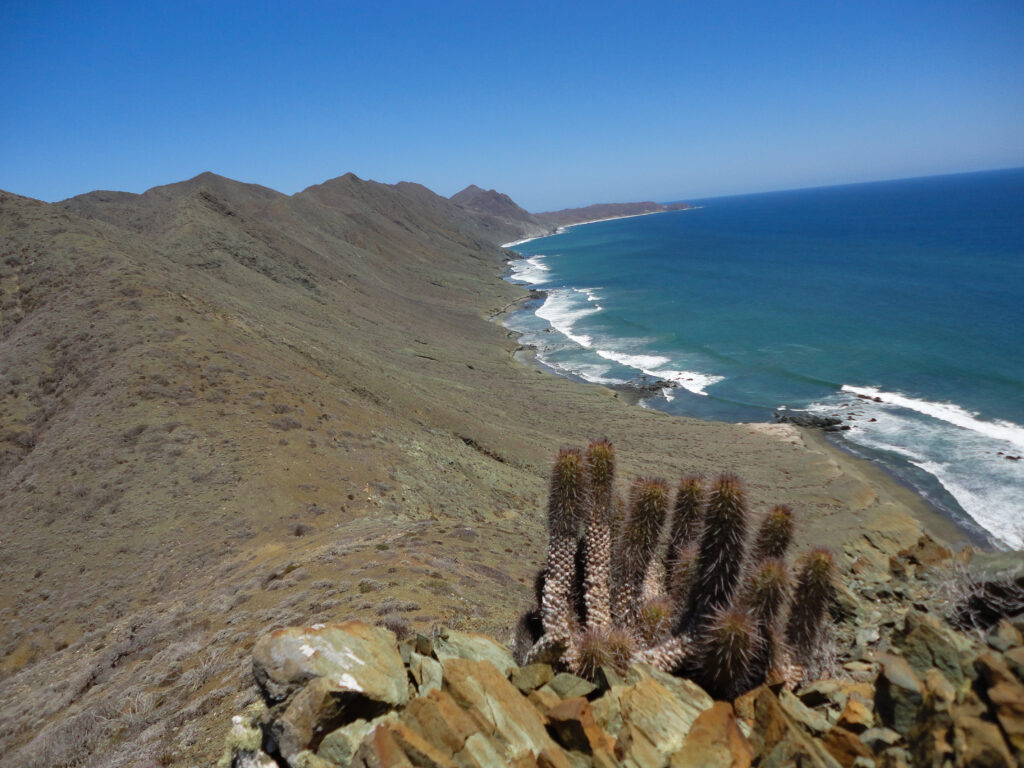
Above, one of my main study species for the Ph.D., Cochemia halei, growing in almost pure serpentine rock on an exposed ridge on Isla Magdalena, one of the main study sites. I miss it and have not been back in too long.
Yet another set of wholly new challenges arose in my first postdoc, which unexpectedly morphed into a plant ecology project. I was originally hired to do a population viability analysis of the saguaro population on Tumamoc Hill but that got postponed in favor of a study of where saguaro cacti have been establishing over the past 40 years and what some of the microsite (1 m) characteristics are that are correlated with establishment. This relatively simple-sounding project ended up taking 2.5 years, but our paper was finally accepted last month, and should be out soon. I worked with researchers who have deep expertise in plant ecology, and it was mind-blowing. The entire process was almost like getting a second advanced degree.
Now I’m embroiled in steep learning curve #….whatever. Namely, building integral projection models for our saguaro population on the Hill, in order to make some projections for what the future holds for this saguaro population. I’ve already been finding some very interesting patterns in our long-term survey data, stretching back to 1964. For example, the below plots of raw annual growth rate (change in height/years between surveys) for all of our time intervals. I’m still poring over these but a few things are of interest to me. One thing is that growth rate doesn’t seem to be affected much by aspect (our survey plots are oriented to the four cardinal directions). That could be wrong of course, and disaggregation by plot will be important. Also, the severe drought period between 1993 and the present seems to show a heavy impact on plants over about 2 m, with growth dramatically flattening. The pattern is very interesting and I hope our further data crunching explains it.
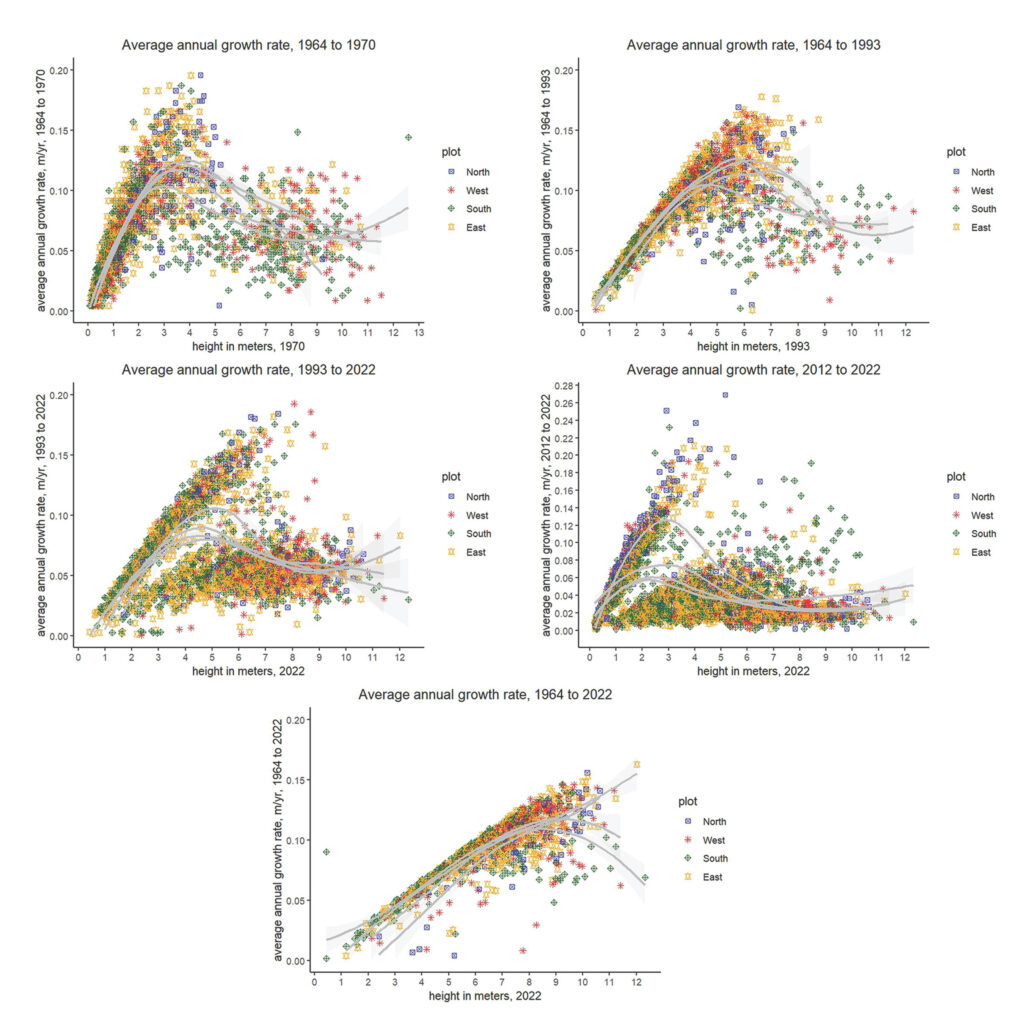
Average annual growth rate for all saguaros between various survey periods. Colored/shaped by plot (north, south, west, east). The gray lines are loess curves for each plot.
Getting a Ph.D. from age 52 to age 58 was an incredible experience, and the most challenging thing I’ve ever done. Well, except for publishing three chapters of the dissertation and doing a postdoc in a completely new field.
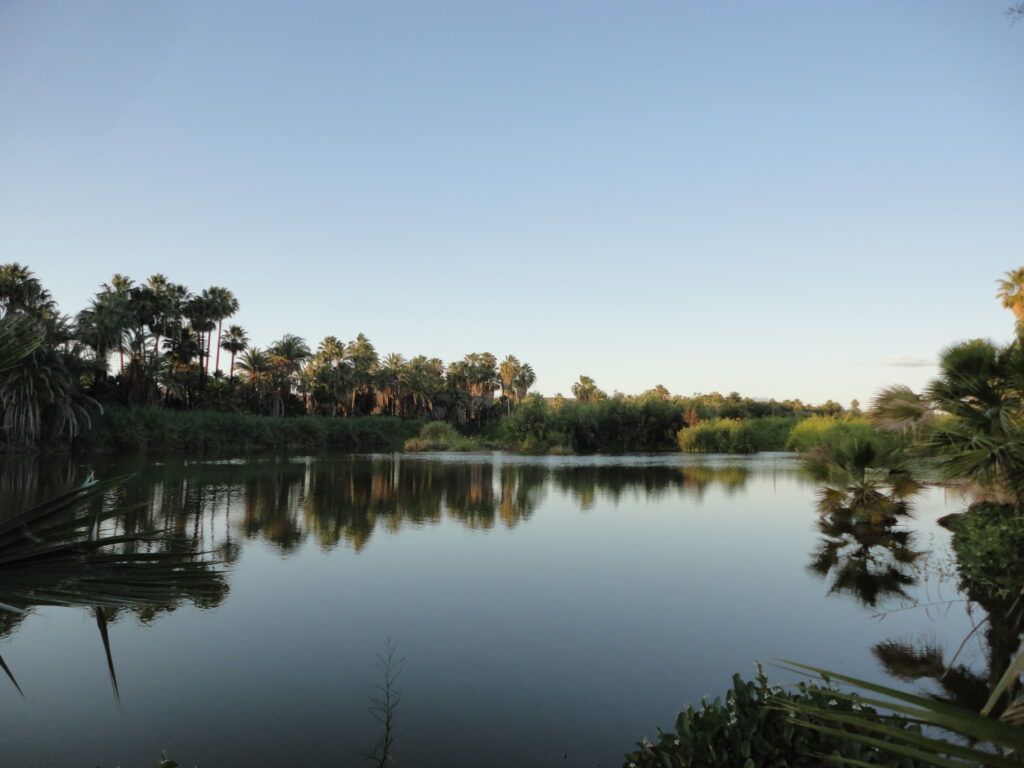
A nice peaceful view of the river in San Ignacio, BCS, at a little campsite right on the water called Los Petates.
I wouldn’t trade any of this for anything though, that’s for certain.